Two custom golf bags can look identical on a product photo and behave completely differently the first time a squall rolls across the back nine. One keeps a set of grips and a rangefinder dry through eighteen holes; the other lets water wick through the stitch lines and pool in the base. The difference is almost never the logo or the color. It is the construction, and the words used to describe it — water-resistant versus waterproof — are not interchangeable, even though catalogs often blur them.
If you are ordering bags with your club, brand, or event name on them, you are committing to whatever that construction is across the whole run. Getting the terminology and the ratings right before you approve a sample is the cheapest insurance you can buy.
Water-resistant and waterproof are not the same claim
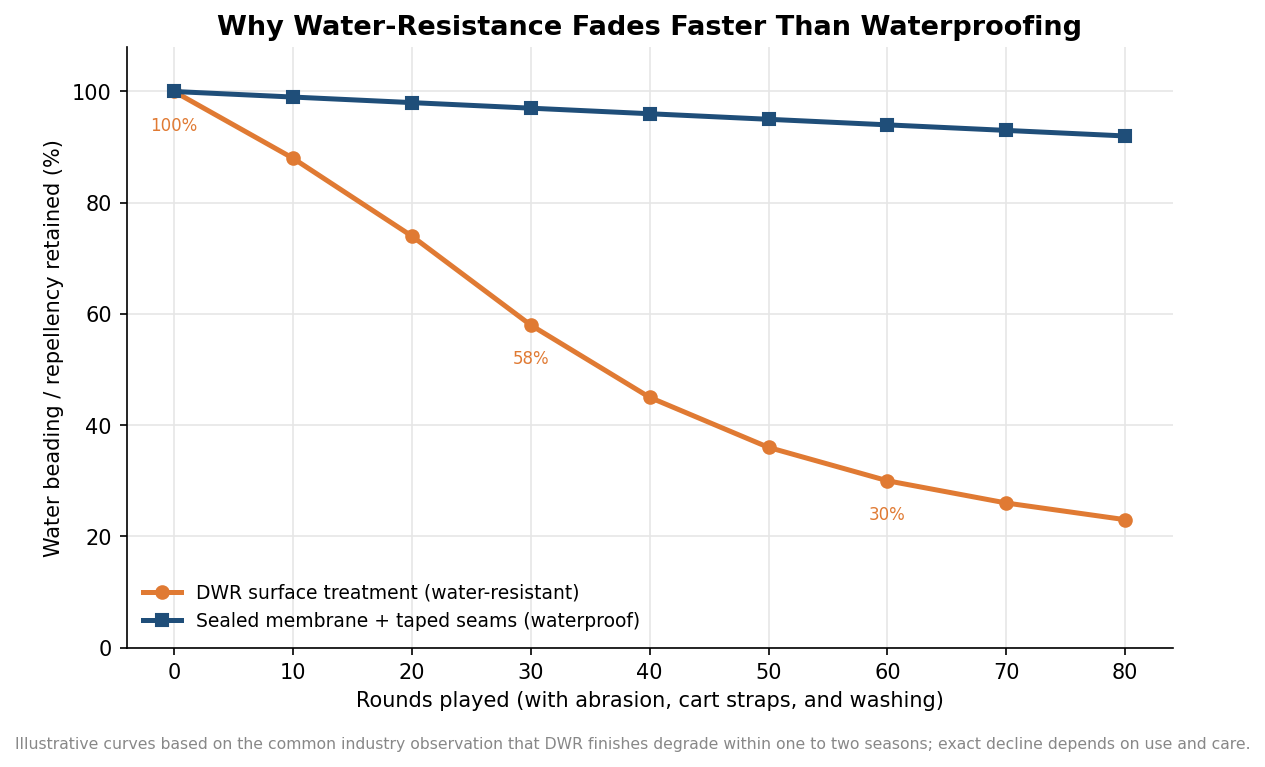
A water-resistant bag relies on a surface treatment. The most common is a durable water repellent, or DWR, coating applied to the outer polyester or nylon so that light rain beads up and rolls off instead of soaking in. It works, but only within limits: DWR handles a passing drizzle or morning dew, not a sustained downpour, and the finish wears down with abrasion, cart straps, and cleaning. It is realistic to expect a DWR surface to lose much of its beading within one to two seasons of regular play, which is why a bag that shrugged off rain when it was new can start letting water through a year later.
A waterproof bag blocks water structurally rather than cosmetically. That means a bonded or laminated membrane behind the face fabric, seams that are taped or welded rather than just sewn, and zippers built to resist water rather than channel it. The membrane is doing the same job as the one in a hiking shell: it physically stops liquid water from passing while the sealed seams and zips close off the gaps around it. Because the protection is built into the structure, it does not wash off the way a surface coating does.
What the ratings actually measure
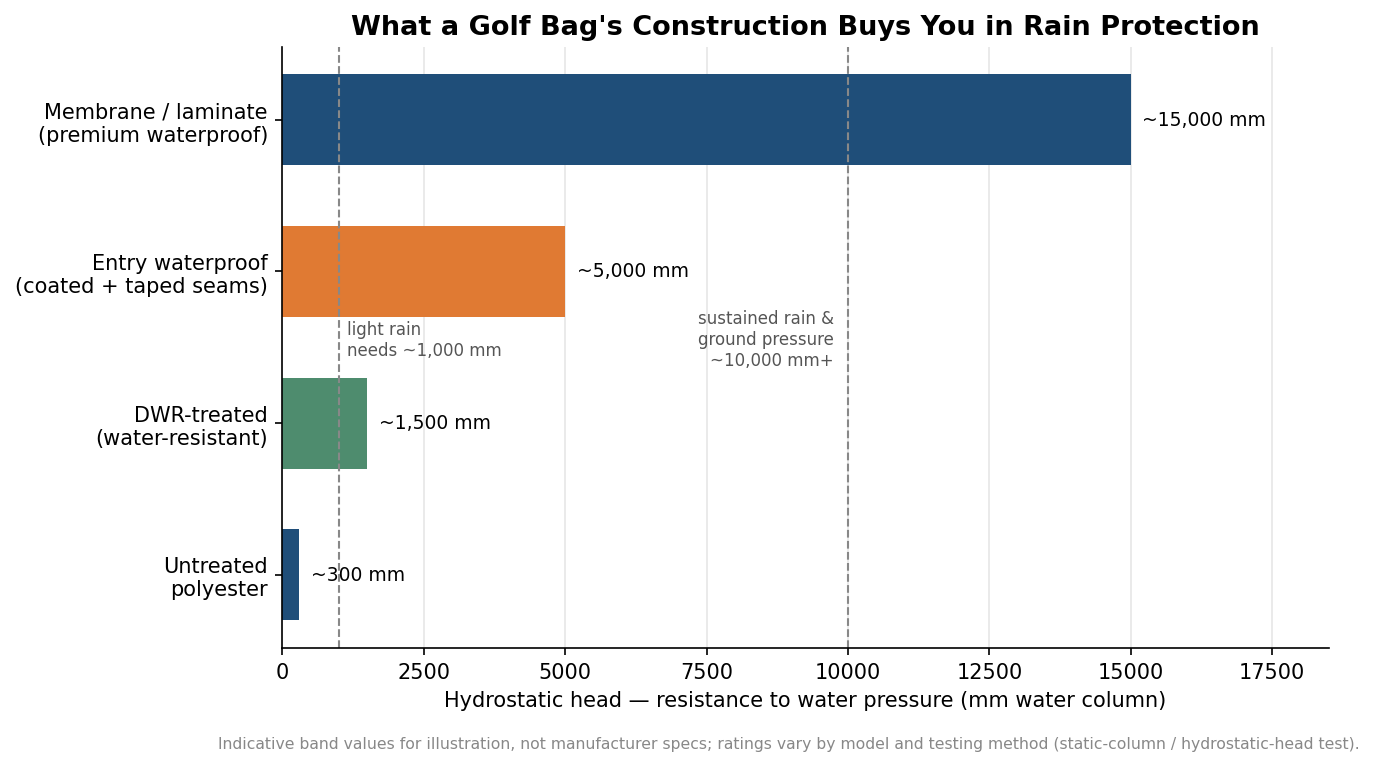
When a manufacturer puts a waterproof number on a fabric, it almost always comes from a hydrostatic-head test, sometimes called a static-column test. A sealed tube of water is placed against the fabric and filled until moisture is forced through; the height of the water column at the point of leakage, measured in millimeters, is the rating. Higher millimeters means the fabric withstands more pressure before it leaks.
As a rough frame of reference, untreated fabric fails almost immediately, a light-rain threshold sits somewhere around 1,000 mm, and fabrics built to handle sustained rain and the pressure of sitting on wet ground are generally rated 10,000 mm or higher. Treat those numbers as indicative bands rather than hard cutoffs, because test methods and reporting vary between mills. The practical takeaway is simpler than the math: a rating tells you about the fabric panel, not the finished bag. A 15,000 mm fabric with unsealed seams and open coil zippers will still leak, because the water is not going through the panel — it is going through the holes.
Where water really gets into a golf bag
Understanding the leak points is what lets you write a useful spec. Seams are the biggest one. Standard stitching punches thousands of needle holes along every seam, and each hole is a channel. Taped or welded seams lay a continuous strip over that stitch line and close the channels; this is the single feature that most separates a genuinely waterproof bag from a merely coated one.
Zippers are the second. An ordinary coil zipper leaves small gaps between the teeth that behave like a row of tiny gutters. Water-resistant zippers — YKK AquaGuard is the most commonly referenced example — add a laminated backing or a storm flap that sits over the teeth so water sheds off instead of seeping through. The top opening is the third: even a well-sealed bag needs a fitted, elasticated rain hood that covers the entire club opening and stays put, or rain simply falls straight down into the club well. Named systems like Titleist’s StaDry exist precisely because pulling all three of these together — membrane, taped seams, sealed zips, and a proper hood — is what earns a true waterproof claim.
What to specify on a branded bulk order
When you are buying one bag for yourself, you can just read reviews. When you are buying dozens or hundreds with your identity on them, ambiguity gets expensive, so put the construction in writing. Decide first whether the use case actually needs waterproof or only water-resistant. A tournament tee-gift that spends most of its life in a clubhouse or a car trunk may be fine as a water-resistant bag at a lower cost, while a staff bag that lives outdoors in a caddie program should be specified waterproof.
If you need waterproof, ask the supplier to confirm the specifics rather than accepting the word alone: a laminated or coated fabric with a stated hydrostatic-head figure, taped or welded seams, water-resistant zippers on the pockets that matter, and an included rain hood. It is also worth confirming that the decoration method does not compromise the shell — embroidery needle penetrations on a waterproof panel can themselves become leak points unless they are backed or placed on a non-critical panel, so it is a fair question to ask how your logo is applied on a waterproof build. Where a supplier gives you a rating, ask whether it describes the fabric or the finished bag, because as noted above those are different claims.
Keeping the protection you paid for
Both constructions last longer with basic care, but they age differently, and that shapes what you tell recipients. A water-resistant, DWR-treated bag benefits from being kept clean, since dirt and body oils break down the beading, and its repellency can often be partially revived with a spray-on reproofing treatment once it starts wetting out. A membrane-based waterproof bag needs less babying to stay waterproof, but its seam tape and zipper flaps are the parts that eventually wear, so the failure mode is different: it tends to start leaking at a specific seam or zipper rather than across the whole surface.
None of this requires you to become a materials engineer. It requires you to treat “waterproof” as a construction spec instead of a marketing adjective, to know that the rating describes a panel and not a promise, and to write down the three things — sealed seams, protected zips, and a real rain hood — that decide whether the bags you order keep their contents dry on the day it actually rains.