Golfers argue about brands, but the decision that actually determines whether a bag suits a player — or a whole team — is the type. Staff, cart, stand, and carry bags are built to different weights, hold different numbers of clubs cleanly, and carry different amounts of gear. For a branded or bulk order the type also drives your embroidery real estate and your freight cost, so it pays to compare the specs before the logo. Here is how the four main categories stack up on the numbers that matter.
Empty weight: the spec players feel first
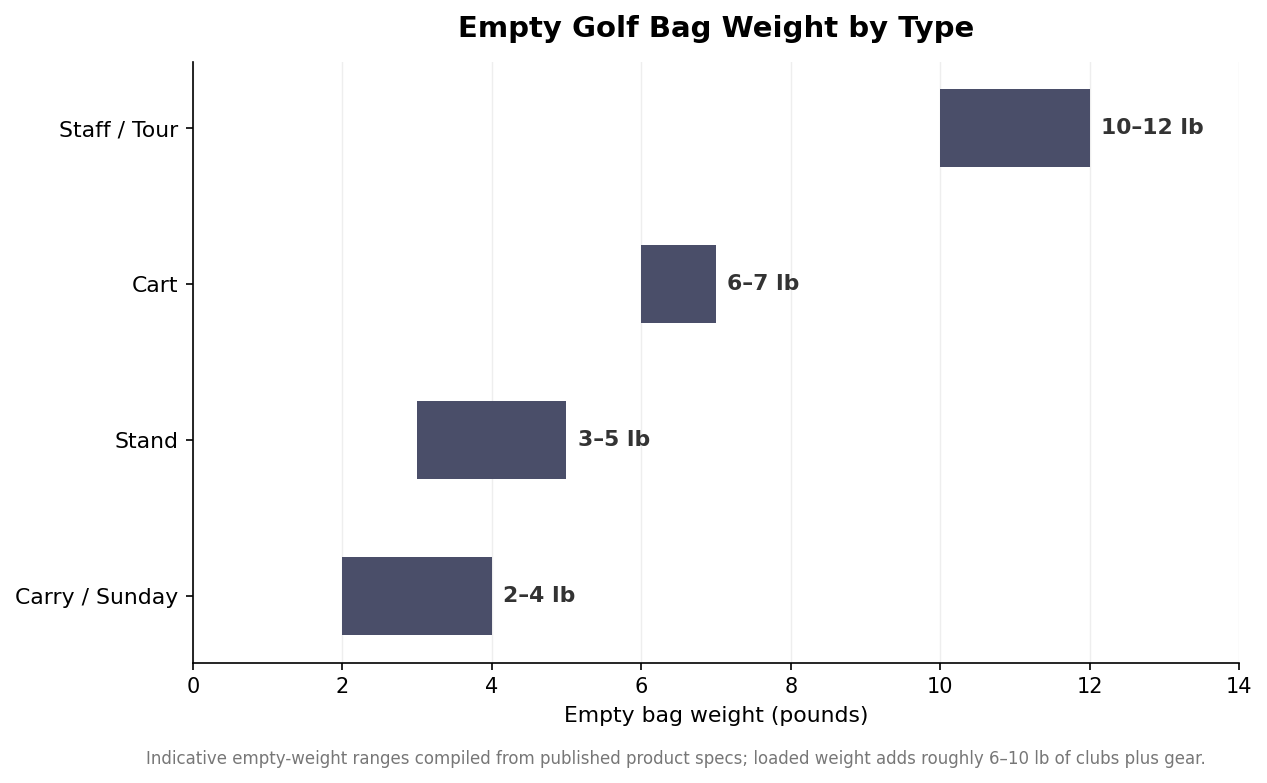
Weight is the clearest divide between the types, and it scales with how the bag is meant to travel. Carry and Sunday bags are the lightest, roughly 2 to 4 pounds empty, because they are designed to hang off a shoulder for eighteen holes with a minimal kit. Stand bags add a spring-loaded leg mechanism and more storage and land around 3 to 5 pounds. Cart bags, which never have to be carried, trade weight for features and sit near 6 to 7 pounds. Staff and tour bags top the range at roughly 10 to 12 pounds empty, before a single club goes in.
Add a full set and gear and every number climbs by another 6 to 10 pounds. That matters for who will actually handle the bag: a carry bag that a walking golfer loves becomes punishing as a staff bag, while a staff bag that looks commanding on a cart is a poor gift for someone who walks. Match the empty weight to how the recipient plays, not to how impressive the bag looks in a photo.
Divider count: how the clubs are organized
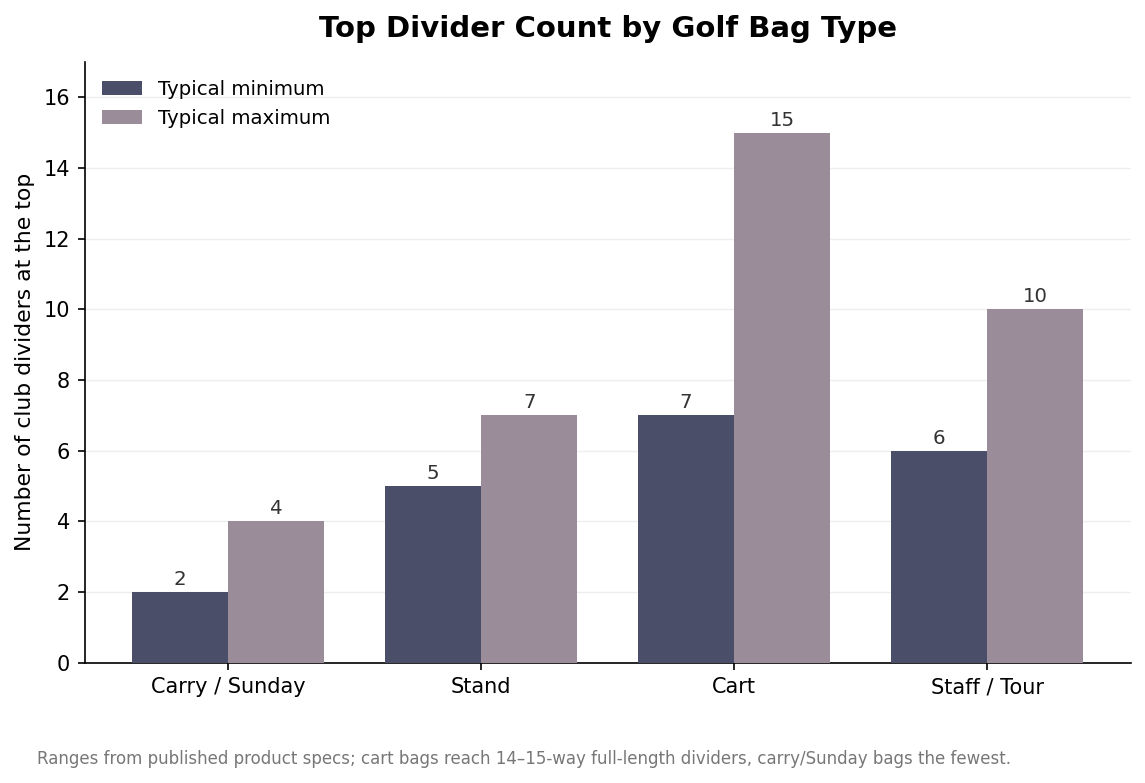
The top of the bag is divided into slots, and the count ranges widely. Carry and Sunday bags keep it simple with 2 to 4 dividers, enough to separate a partial set. Stand bags usually run 5 to 7. Cart bags go the furthest, from about 7 up to 14- or 15-way tops, and staff bags sit around 6 to 10 larger openings sized for oversized grips.
More slots is not automatically better. A 14-way full-length divider keeps every club in its own channel from top to bottom, which prevents shafts from clacking together and protects graphite from wear — genuinely useful for an expensive set that rides a cart all season. But full-length dividers add weight and can grip clubs tightly enough that pulling one is fiddly. A 5- or 7-way top is lighter and lets you grab clubs faster, at the cost of some tangling. For a giveaway set that will see occasional use, the simpler top is often the smarter spec.
Pockets and storage: matching capacity to the outing
Pocket count roughly tracks the same order as weight. Carry bags offer a few small pockets for a handful of balls, tees, and a phone. Stand bags step up to several pockets, usually including a valuables pocket and room for a rain layer. Cart and staff bags carry the most, with large apparel pockets, insulated pockets for drinks, dedicated rangefinder and glove pockets, and a lined valuables pocket. Because cart and staff bags do not have to be lifted, designers can afford that volume.
Think about the outing rather than maximizing storage. A corporate scramble where players ride carts and want a cooler pocket points to a cart bag; a member-guest gift for golfers who walk points to a stand bag. Buying more pockets than the recipient will use just adds weight and cost. It is also worth checking how the pockets open: forward-facing, cart-friendly pockets stay reachable when the bag is strapped to a riding cart, while side-access pockets are easier when the bag stands on its legs. On a bulk order that detail is easy to overlook and irritating to discover after delivery.
What the type means for a custom order
Bag type changes the branding decision as much as the playing decision. Larger cart and staff bags present broad, flat panels that suit a big embroidered crest or a multi-color logo, which is why they dominate as premium corporate gifts and pro-shop resale. Stand and carry bags have smaller, more curved panels, so a clean single-position logo tends to read better than an oversized design that wraps and distorts.
Freight is the other quiet factor. A pallet of 10-to-12-pound staff bags ships heavier and bulkier than the same count of 3-pound carry bags, so on a large order the type meaningfully moves your landed cost per unit. If a budget is fixed, choosing a stand bag over a staff bag can free up real money for better decoration or a higher unit count. Decide the type against the recipient and the budget together, then lock the color and logo.
Choosing in one line
Read it off the player: walkers who want minimal gear take a carry or Sunday bag at 2 to 4 pounds; walkers who want organization and storage take a stand bag at 3 to 5; riders who want maximum features take a cart bag at 6 to 7 with up to a 14-way top; and premium gifts or tournament staff take a staff bag at 10 to 12 with the largest branding panels. Get the type right first, and every other spec — dividers, pockets, weight, and logo placement — falls into line behind it.