Most of the decisions on a custom golf bag order get plenty of attention: the color, the logo placement, the fabric. The divider top usually does not, and it is the one spec a recipient notices every single round. It decides whether clubs stand neatly apart or clatter together, how much the bag weighs on a shoulder, and how quickly someone can pull the right iron on a fast tee box. If you are ordering bags in quantity for a team, a tournament, or a corporate gift, here is how to specify the top so the finished bags actually fit how they will be used.
What the divider number actually counts
When a bag is described as 4-way, 6-way, or 14-way, the number is how many separate openings the top is split into. A 4-way top gives four compartments and suits a partial set or a lighter carry. A 5-way or 6-way top handles a full set of clubs and often adds a dedicated slot for the putter so its wider grip does not crowd the irons. A 14-way top gives one slot per club, which is the maximum level of organization. The counts in between, like 8-way, simply trade off along that same line. More openings mean each club has more of its own space; fewer openings mean clubs share.
The number alone is only half the spec, though, and the more important half is what those dividers are made of and how far down they run.
Full-length versus partial dividers, the split that matters most
Two bags can both be sold as 6-way and behave completely differently. In a partial-divider top, the walls only separate the clubs at the opening; a few inches down, all the shafts drop into one shared cavity where they can still cross, rub, and rattle. In a full-length top, each divider runs the whole way from the collar to the base, so a club is separated from its neighbors along its entire length. That is the version that genuinely protects graphite shafts from scratching against each other, cuts the noise on a moving cart, and stops the tangle that makes you pull two clubs when you wanted one.
For a bulk order this distinction is worth writing into the spec in plain words, because “6-way” on its own does not tell your supplier which one you mean. If the bags are carrying nicer clubs, or if they are premium gifts meant to feel high-end in the hand, full-length dividers are usually the detail that separates a bag people keep from one they replace.
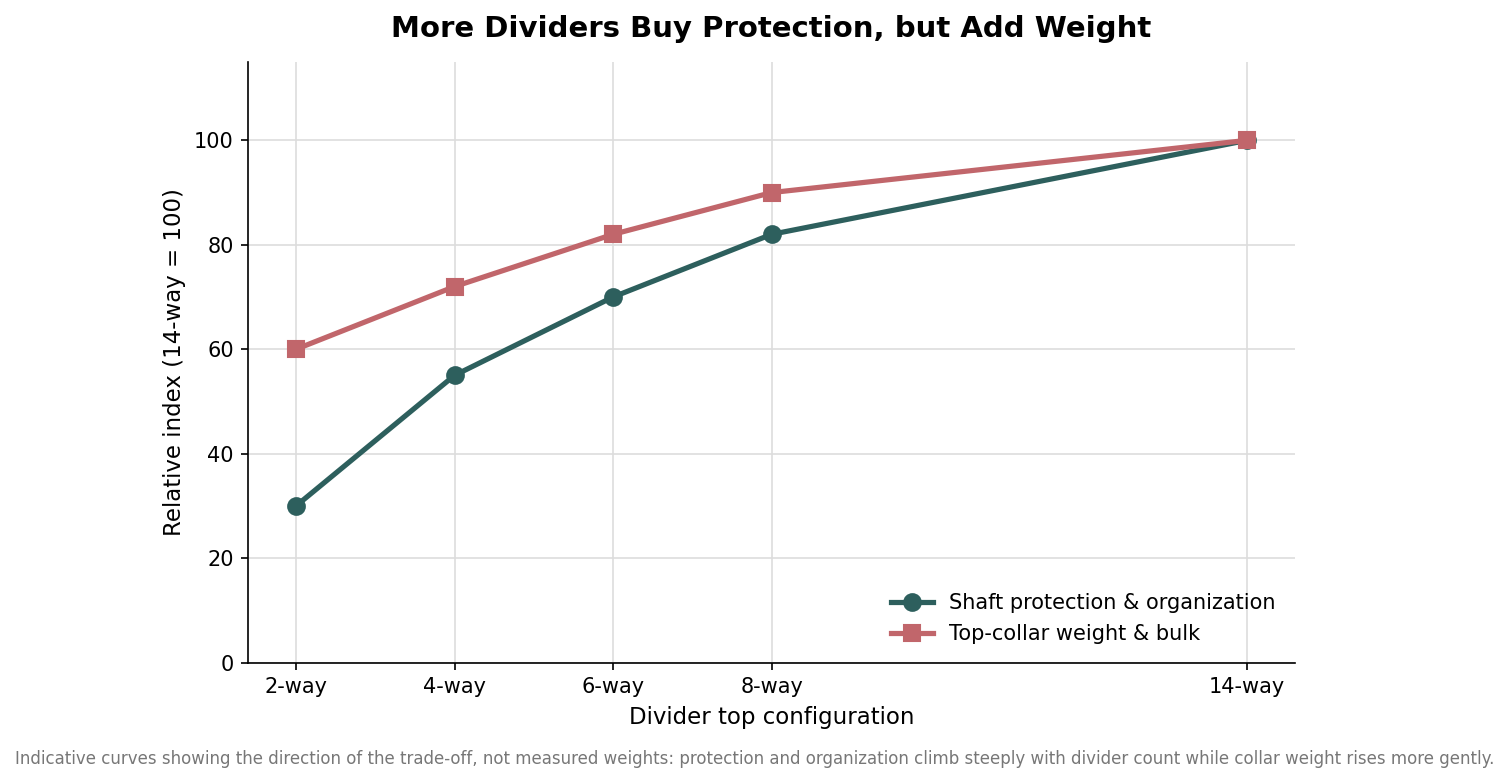
The chart above shows the shape of the core trade-off. As you add dividers you gain protection and organization quickly, while the weight and bulk of the collar climb more gently. The gap between a 6-way and a 14-way top, for instance, is often only a fraction of a pound of hardware, which is why the choice usually comes down to how the bag travels rather than how heavy it is.
Matching the divider count to how the bag will be used
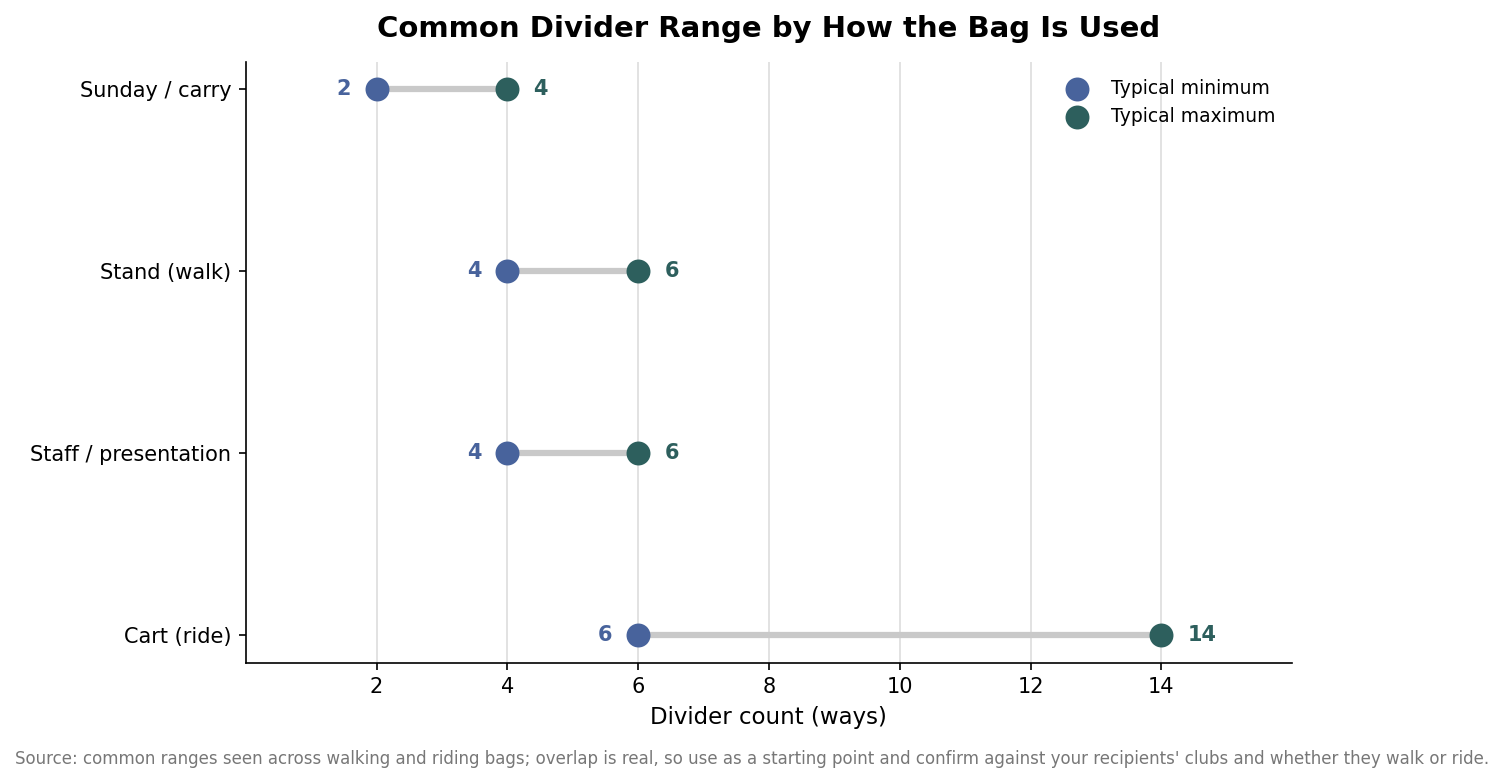
The single best predictor of the right top is whether people will walk with the bag or ride with it. Walkers carry every ounce, so carry and stand bags lean toward fewer, lighter dividers, commonly in the two-to-six range, with four to six being the sweet spot for a full set that still shoulders comfortably. Riders let the cart carry the weight, so cart bags can justify the heavier, more organized tops all the way up to a full 14-way, and they benefit from it because the bag sits still and upright while clubs come in and out.
Staff or presentation bags, the large-format bags used for display or high-visibility branding, usually run a modest divider count with big openings, because their job is presence and logo real estate more than granular club separation. The chart below maps the common ranges by use so you can pick a starting point, but treat the overlap as real: a walking golfer who babies their clubs might still want a full-length 6-way, and that is a fine call.
What more dividers cost you
Adding openings is not free, and the costs show up in three places. The first is weight and bulk: more walls and a wider collar add material, which matters most for bags that get carried. The second is the top opening size: a 14-way collar is physically larger around than a 4-way, which changes how the bag looks and, on a cart bag, how it seats in a cart’s bag well. The third is cost per unit, since a full-length 14-way top is more to manufacture than a simple 4-way, and across a few hundred bags that difference adds up. None of these should scare you off the organized tops; they just mean the right answer is the lowest divider count that still does the job, not the highest count available.
There is also a subtle usability note worth knowing: on some very tightly slotted 14-way tops, thick grips can bind slightly when clubs are packed in, making them a touch harder to pull. Quality tops solve this with roomier individual slots, so if you go to a full 14-way, it is worth confirming the openings are sized for standard and oversize grips alike.
Locking one spec across a bulk order
The advantage of a custom order is standardization, and the divider top is where that pays off. Decide the count and, just as importantly, the full-length-versus-partial question once, then apply it to every unit so the whole batch behaves identically. Write the spec as a complete phrase, for example “6-way full-length divider top with a dedicated putter well,” rather than a bare number, so nothing is left to interpretation on the production line.
If you are unsure, start from how the recipients will move around the course, choose the fewest dividers that give a full set its own space, and default to full-length walls whenever club protection or a premium feel is part of the point. Get the top right and the rest of the bag, the color, the logo, the pockets, gets to shine on a bag that simply works the way its owner expects every time they reach for a club.